


“She brings me the zebra one. Pulls it out, pushes it back, looks at me, waits. We have done that page more times than I can count and I am not bored of it yet.”
Danielle P. · mum of a 20 month old
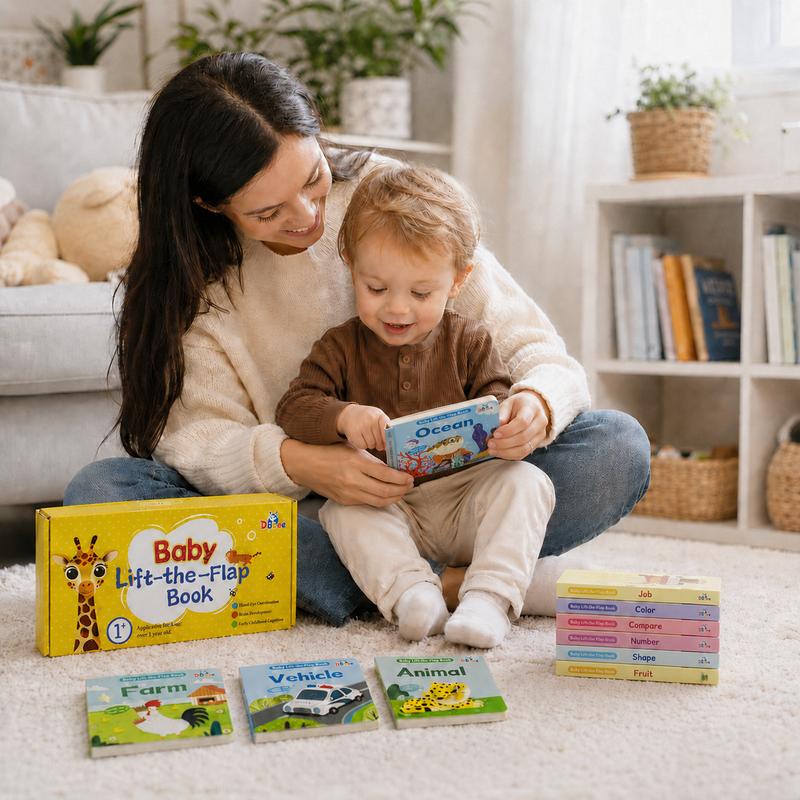
10 interactive board books · ages 1 to 3
One word a page, printed big beside the picture it names, with something to lift, slide or pull that makes your toddler want to hear it again.
“He slid off my lap by page two of every book we owned. These have one word and something to lift, so he stays. We have done the zebra page so many times I hear it in my sleep.”
Megan R. · Verified Buyer
Arrives in a rigid gift box, so the second one is already wrapped. Free US shipping and 30 days to send it back.
Open a normal picture book with a toddler who is still collecting single words and the page is mostly talking. Four or five sentences, a crowded illustration, and nothing held still long enough for them to attach a sound to.
These are built the other way round. The word is the biggest thing on the page. Beside it is the one picture that means it. There is nothing else to look at, so there is nothing to work out.
Then the page gives them something to do with their hands. Lift the snowdrift and find the seal. Push the tab and the elephant moves. That reveal is what buys the repetition. They want to do it again, so the word gets said again, and you never had to push for it.
A book set, not a programme. There is nothing to follow and no order to keep to. Open whichever one they hand you.
One book, one sitting. Five minutes is plenty, and it is better done twice a day than once for twenty.
You will feel silly saying one word eight times in a row. Every parent does. That is the method, not you doing it wrong.
Same ten books the whole way through. What changes is what you do with them.
Marked for ages 1 and up by the maker. Below twelve months there is nothing here for them yet.
Ten board books, one per topic:
$39.99 for the set. That is $4.00 a book, against $7.99 for a single first-words title on a shop shelf.



You say it slowly. You say it again. You peel the paper banana back a second time because that is the bit they like, and you say it once more.
It feels faintly ridiculous the first week. It is also exactly the shape of practice that a one or two year old can actually use: one word, held still, next to the thing it means, repeated as many times as they want it.
That is the whole design of these ten books. Not a story to sit through. A word, a picture, and something to do with your hands.
Every page is the same simple shape, so there is nothing new to work out each time you open one.

The word sits big and clear beside the thing it names, and nothing else competes for the page. Point at one, say the other.

Animals, ocean, numbers, colours, jobs, opposites, vehicles, shapes, the farm and fruit. A different one each day keeps it fresh.

The page asks who is hiding. They lift the flap to find out. The word comes with a small payoff instead of on its own.

Push the tab and the elephant lifts its trunk. A word attached to a movement is a word they will come back to.

The zebra slides out past the edge of the book to get away from the lion, then slides back in. Ready to do again, which they will.

Under each word is one short sentence to read out. “The watermelon is round like a ball.” Enough to say, short enough to repeat.

Each page is a thick laminated board, so a one year old can separate them and choose the next one without help.

Every corner is cut to a generous radius and sealed around the edge, on all ten books, front and back.

The set arrives in a rigid lidded box the books go back into. It gives without wrapping and keeps the ten together afterwards.

A beautiful picture book is built for a child who can already follow a sentence. Open one with a toddler who is still collecting words and the page is a wall of talking, with nothing on it for them to hold on to.
These are built the other way round. One word, one picture, one thing to do. The word is the biggest thing on the page. The picture is the only other thing on it. And the flap, the slider or the pull-out gives them a reason to ask for the whole page again.
4.8 out of 5 · 326 reviews
“She brings me the zebra one. Pulls it out, pushes it back, looks at me, waits. We have done that page more times than I can count and I am not bored of it yet.”
Danielle P. · mum of a 20 month old
“I felt ridiculous saying ‘banana, banana, banana’ at the kitchen table. Then he said it back.”
Megan R. · Verified Buyer
“Our picture books were too much for him and he would just close them. These he actually sits with, because there is only one word to deal with.”
Priya S. · Verified Buyer
Tap or hover any book to see the words inside it, the line to read out, and one thing to try.

The lion, the zebra, the elephant and the monkey, each with a noise worth making before the word arrives.
See insideWords
Read aloud
“I am the king of all beasts, with a tremendously loud roar!”
The surprise
Pull the zebra out to escape the lion
Try this
Roar first. The sound usually comes before the word.

A lilac reef full of things with long, satisfying names, and more of them hiding behind the coral.
See insideWords
The topic
Sea creatures and the reef they live in
The surprise
Lift the coral to find who is tucked behind it
Try this
Two long words, said slowly. Let them watch your mouth.

Numerals printed big beside the right number of things, so the symbol and the amount land together.
See insideThe topic
Numerals, and counting what is on the page
Peek inside
Big printed numerals beside the animals they count
The surprise
Lift a flap to find the next number along
Try this
Count out loud, then stop just before the last one.

Each colour gets an animal or a fruit that wears it, so the word has something solid attached to it.
See insideWords
Read aloud
“Who is hiding in the snowdrift?”
The surprise
Lift the snowdrift and a white seal is underneath
Try this
Ask the question. Wait a beat longer than feels normal. Then lift.

The firefighter and the rest of the people a toddler already points at in the street, each one doing their job.
See insideThe topic
People at work, and the tools they use
Peek inside
A firefighter, a hose and a red fire engine
The surprise
Lift the flap to see who turns up next
Try this
Make the siren first. Noises are easier to copy than names.

Tall next to short, big next to small. A giraffe and a tortoise on one spread makes the idea obvious without explaining it.
See insideThe topic
Opposites, shown side by side on one spread
Peek inside
A giraffe bending down to a tortoise, tall against short
The surprise
Lift a flap and the other half of the pair appears
Try this
Stretch up tall, then crouch down small. Say it with your body.

The police car and everything else with wheels. Usually the first book out of the box, and the one asked for again.
See insideThe topic
Cars, trucks, and the ones with a siren
Peek inside
A white police car on a road winding through green
The surprise
Lift the flap to see what is coming down the road
Try this
Beep first, then the word. Keep the beep every single time.

A circle sun, a square window, a rectangle door. The shapes are built into a house instead of floating on their own.
See insideThe topic
Shapes, found inside real things
Peek inside
A house: circle sun, square window, rectangle door
The surprise
Open the window to find who is behind it
Try this
Trace the shape with their finger while you name it.

The hen, the rooster, the chicks and the barn behind them. The book that gets read entirely in animal noises.
See insideThe topic
Farm animals and where they live
Peek inside
A white hen, a rooster, yellow chicks and the barn
The surprise
Lift a flap to find who is inside the barn
Try this
Do the noise, then the name, in the same order every time.

The banana that peels and the watermelon that slides open. Food words are the ones they get to use again at lunch.
See insideWords
Read aloud
“The watermelon is round like a ball.”
The surprise
Peel the banana, slide the melon open to the red inside
Try this
Peel it, say it, peel it again. Then hand them a real one.