


Lock lever
Press to lock the vacuum, lift to release. Pivots on a metal pin — no pump to wear out, no knob to strip, no guessing whether it’s holding.
Suction-and-tap repair. A 160-lb vacuum grip locks onto laminate, vinyl, hardwood or engineered planks; one tap on the padded strike block slides the board home. No pry bar, no gouged edges, no pulling the baseboard off.
Every floating floor drifts. This is how you pull it back.
“I was sure the cup would pop off the second I tapped it. It didn’t budge — three hallway gaps closed in twenty minutes, no pry bar, and not a scratch on the vinyl.”
Marcus D. • verified buyer
Free US shipping · 30-day money-back · ships from the U.S.


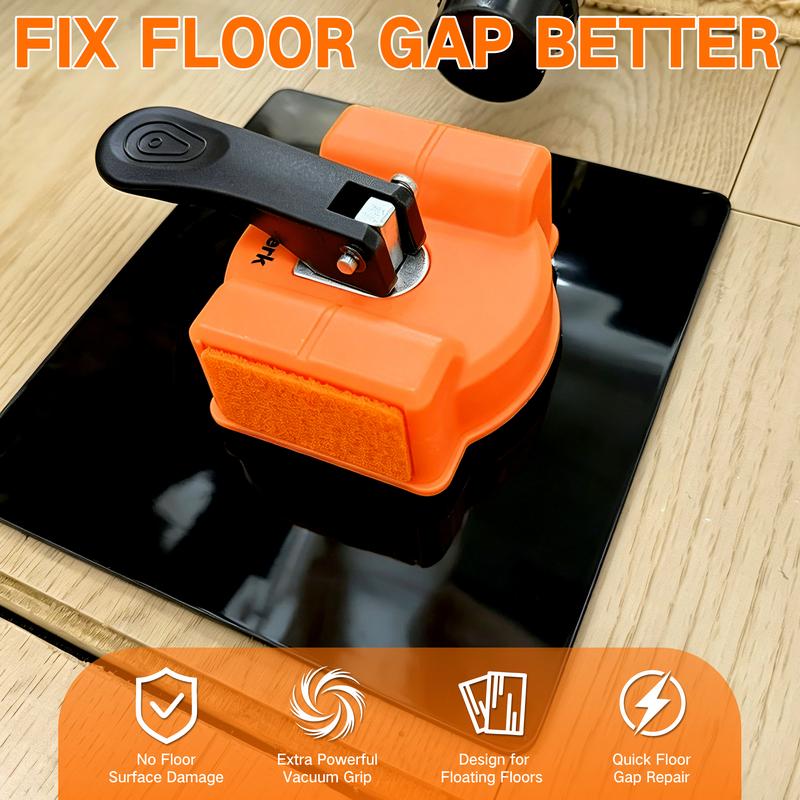

A 160-lb suction grip and a padded strike block slide floating planks back together — no pry bar, no scratches, no baseboard coming off.
VacuGrip™ 160-lb suction base
A wide non-marking rubber cup rated to 160 lb of grip. It holds the plank, not the finish.
StrikeBlock™ padded tap plate
Felt over impact plastic. It takes the hits so the plank doesn’t — tap after tap, winter after winter.
SealPad™ sticky pads
One washable, reusable pad plus two sticky pads so the cup seals on textured and hand-scraped planks.
LockLever™ release
Press to lock the vacuum, lift to let go. A metal-pinned lever — no pump to wear out, no knob to strip.
Floating-floor safe
Laminate, luxury vinyl plank, engineered and solid hardwood — anything click-lock that floats.


Clean, press, tap. The plank slides home, the seam closes, and nothing sharp ever touches the edge of your floor.

Why floating floors gap
Laminate, vinyl plank and engineered boards click together and float on the subfloor. Dry winter air shrinks them, foot traffic nudges them, and one day there’s a dark line in the hallway. The usual “fix” — a pry bar or a crowbar — chews the very edge you’re trying to save.

VacuGrip™ suction
Set the cup on the plank, press the lever, and 160 lb of vacuum grip locks on from above. No hooking the edge, no wedging under the board — the finish never meets metal.

StrikeBlock™ tap plate
The orange block takes the hit so the plank doesn’t. Firm, even taps with a rubber mallet move the board a little at a time — sideways, into the gap — until the seam is tight. Felt padding absorbs the strike; the suction does the pulling.

SealPad™ sticky pads
A suction cup needs a smooth surface. On hand-scraped, embossed or deeply grained planks, lay the black reusable pad down and set the cup on it — full seal, full grip. Rinse the pad, let it dry, and the tack comes back. Two extra sticky pads are in the box for stubborn spots.

Every floating floor
If the planks click together and float, this closes the gaps between them. Kitchen laminate, hallway LVP, the engineered oak in the living room, a floating solid-hardwood install — one tool, every room.

Built to be hit
This isn’t a one-job gadget. The body is impact plastic, the strike face is felt over hard plastic so the mallet never meets bare housing, the lever pivots on a metal pin, and the cup is thick molded rubber that reseals with a wipe. Close the gap, lift the lever, drop it in the drawer — it comes back out when the air dries out again.
Press to lock the vacuum, lift to release. Pivots on a metal pin — no pump to wear out, no knob to strip, no guessing whether it’s holding.

The face you hit. Felt over impact plastic spreads every strike, so the block takes the hits and the mallet never marks the tool.

Wide, thick molded rubber. Rated to 160 lb of grip, reseals with a wipe, and leaves nothing behind when you lift it.

The tool, one reusable sticky pad and two sticky pads. Bring your own rubber mallet.

One compact tool that lives next to the mallet and comes out once a season. No parts to lose, nothing to recharge.

Rated suction grip
Saucer-sized cup, non-marking rubber
Which floors
Ceramic or stone tile set in mortar won’t move. Click-lock vinyl and laminate tiles work like planks.
Marcus D.
Hallway LVP · Homeowner
★★★★★
Thought the cup would pop off. It didn’t.
I was sure the cup would pop off the second I tapped it. It didn’t budge. Three hallway gaps I’d been staring at for a year closed in twenty minutes — no pry bar, and not a scratch on the vinyl.
Verified buyerPriya N.
Laminate kitchen · First-time DIY
★★★★★
I am not a tool person and this worked
The whole instruction is clean, press, tap. The planks moved more easily than I expected and the finish looks untouched. Weirdly satisfying.
Verified buyerTom G.
Engineered oak · Winter gaps
★★★★★
Fixes the February gaps every year now
Our engineered floor opens up every winter when the furnace dries the air out. This pulls the boards back without lifting a single baseboard. It went from a dread to a once-a-year chore.
Verified buyerAngela F.
Vinyl plank · Rental
★★★★☆
Works — clean the floor first
First try the cup wouldn’t hold because there was dust on the plank. Wiped it with a dry cloth like the instructions say and it locked solid. Also: you need your own mallet, it doesn’t come with one.
Verified buyerChris O.
Handyman · 20+ floors a year
★★★★★
Replaced my pull bar for click-lock jobs
I do a lot of floating-floor repairs and this is faster than a pull bar for anything in the middle of a room. Hundreds of taps in, the felt’s still on the block and the cup still seals. Suction holds, the plank walks over.
Verified buyerDana W.
Laminate living room
★★★★★
No damage, which was the whole point
I’d already gouged one board trying a crowbar. This grips from the top, so nothing touches the edge of the plank. Gap closed, board saved, lesson learned.
Verified buyerLuis V.
Textured vinyl · Hallway
★★★★☆
Use the black pad on textured floors
On my hand-scraped vinyl the cup alone wouldn’t seal. The reusable black pad under it fixed that instantly. Five stars if the box said that louder.
Verified buyerHeather S.
Hardwood · The dog-bowl corner
★★★★★
The corner by the dog bowl is finally flat
Years of a wet corner had the boards drifting apart. Two taps per plank and the seam is tight again. Rinsed the pad, back in the drawer till next time.
Verified buyerRated suction grip. It holds the plank, not the finish.
Pry bars, crowbars, or gouged plank edges.
Clean the plank, press the lever, tap the block.
Not sure it’ll close your gap?
Try it for 30 days. If the plank won’t budge, send it back.
Shop nowStraight answers
On a clean, smooth plank, yes — the cup is the same wide-ring design glass installers use to carry heavy panes, rated to 160 lb of grip. Only two things break the seal: grit under the cup, and a textured plank. Wipe the board first, and lay the black reusable pad down on hand-scraped or embossed floors.
Not from tapping. The block is fixed to the housing and its face is felt over impact plastic — firm taps are all a floating plank needs. If you ever find yourself swinging hard, stop: the plank is caught on something (a broken tongue, a fixed board), and no tool should force it.
The cup is non-marking rubber and lifts clean. The strike force travels sideways through the block, never down into the finish, and nothing hooks or wedges the plank edge — which is exactly what a pry bar gets wrong.
A pull bar hooks the last plank at the wall and needs the baseboard off to work. It does nothing for a gap in the middle of the room. This grips any plank, anywhere, from the top — and the baseboard stays on.
Floating floors move with the seasons, so a year from now it might. Two minutes with the same tool closes it again — nothing to re-buy, no one to call.
Your floor
Floating, click-lock floors: laminate, luxury vinyl plank, engineered hardwood, and solid hardwood laid as a floating install. The tool slides the plank sideways — so the floor has to be the kind that can move.
No. Those planks are fixed in place, so there’s nothing to slide. Gaps in a glued or nailed floor need color-matched filler or a board replacement.
The everyday kind: the thin lines that open up when planks shrink in dry air or creep under foot traffic. If the gap came from a snapped locking tongue or a sagging subfloor, the plank will move but won’t stay put — that board needs replacing.
Click-lock vinyl and laminate tiles that float work exactly like planks. Ceramic or stone tile set in mortar won’t move.
Using it
Yes — any rubber or dead-blow mallet you already own; one isn’t included. Tap the felt-padded strike block, never the suction housing or the lever.
Firm, even taps. The plank walks over a little with each one — let the suction do the holding and the block do the pushing. You don’t need to swing hard, and you shouldn’t.
On smooth planks the cup seals on its own. On textured, hand-scraped or embossed planks, lay the black reusable pad down first and set the cup on it for a full seal. The two clear sticky pads are extras for stubborn spots.
Care & durability
There’s nothing in it to wear out quickly: an impact-plastic body, a felt strike face, a thick molded-rubber cup and a metal lever pin. Wipe the cup, store it with the lever released, and it comes out every winter. And if it isn’t what you expected, the 30-day money-back covers it.
Wipe it with a dry cloth before every use. If the rubber picks up grime, rinse it under water and let it dry completely before the next job.
Yes. Rinse it under water, let it air-dry, and the tack comes back. Store it flat on its backing sheet.
Lift the lever so the cup isn’t left compressed, and keep it in a drawer out of direct sun. It’ll be ready the next time the air dries out.
Service & support
30 days from delivery. If it doesn’t close your gap, send it back for a refund of the purchase price.
Orders ship from our U.S. warehouse with free U.S. shipping. You’ll get tracking by email as soon as it’s on the way.
Message us with a photo and we’ll sort out a replacement. No forms, no arguing.
Clean, press, tap. A 160-lb grip and a strike block built to be hit put floating planks back where they belong — this winter and the next — without a pry bar ever touching your floor.
Add to cart — $29.99Free shipping across the contiguous United States
30-day money-back guarantee — if the plank won’t budge, send it back
160-lb non-marking suction — no pry bar, no gouged edges